Run Longer. Fuel Smarter. Finish Stronger.
Your body carries thousands of calories of stored energy. Learn how to access more of it when you run.
You train your legs to go farther. You train your heart to work harder. But what about the engine that fuels every mile?
Optimized Fat Metabolism (OFM) helps endurance athletes develop the ability to use more of their own stored fat for energy — helping preserve glycogen, support steadier energy, and reduce the dependence on constant carbohydrate intake.
You trained for the distance. But did you train your fuel system?
You can spend months preparing for a marathon or ultra.
Long runs. Tempo workouts. Intervals. Hill repeats. Recovery days.
Then race day arrives.
- You start strong.
- Mile 10 feels great.
- Mile 16 gets harder.
- Mile 20 becomes survival.
The problem may not be that you aren't eating enough.
It may be that your body has become too dependent on the fuel you’re putting into it.

Ultra Field · 100-mile trail
Ironman Field · Long-course triathlon
Adventure Racing Field · Multi-day expedition

Your body already carries fuel.
A runner’s body stores energy as glycogen — but it also carries a much larger reserve of energy in the form of body fat.
The question isn’t whether you have enough fuel.
The question is whether your metabolism can effectively access it when you need it.
That’s where metabolic flexibility becomes important.
Instead of relying almost entirely on continuously supplied carbohydrate, the goal is to develop a metabolic system capable of drawing from multiple fuel sources.
- More metabolic flexibility.
- Less dependence on constant refueling.
- More capacity for the miles ahead.
A catalyst and a system to get you to your potential.
Metabolic health & performance merge as a metabolic state attained through harnessing the available tools of diet, physical activity, supplements and lifestyle to achieve your metabolic potential.
There is no simple formula because each person is different.
It is not one thing but everything which makes achieving your health & performance goals complicated and daunting.
Fortunately, we’ve developed the products and program which give you a jump-start and a step-by-step roadmap to restoring your native physiology then developing your potential.
Our offerings are time tested (25+ years), developed at the very pinnacle of sports & ultra-endurance competition and based upon an evolutionary biology model instead of modern life to deliver real world results.

VESPA
A metabolic catalyst in a naturally occurring peptide derived from the Giant Asian Wasp (known as the “Murder Hornets”) that signals your body to mobilize and metabolize fatty acids — sparing glycogen, flattening the glucose swings, and letting you fuel on what you are already carrying.
- VESPA CV-25 — The original ready-to-use formulation containing 100 mg of wasp extract peptide. Just shake and consume a full pouch 30 minutes prior to physical activity. Natural ingredients. Low sugar/low calorie. No stimulants.
- VESPA Ultra Concentrate (UC) — Highly concentrated (175 mg of Wasp Extract Peptide) and requiring dilution, VESPA UC is designed for maximum portability and duration when logistics warrant.
- VESPA Junior (JR) — VESPA JR combines 8 grams of carbohydrate from Orange Juice & Honey with 70 mg of wasp extract peptide for a quick acting performance boosting formula perfect for youth team sports and other high level activities.
OFM
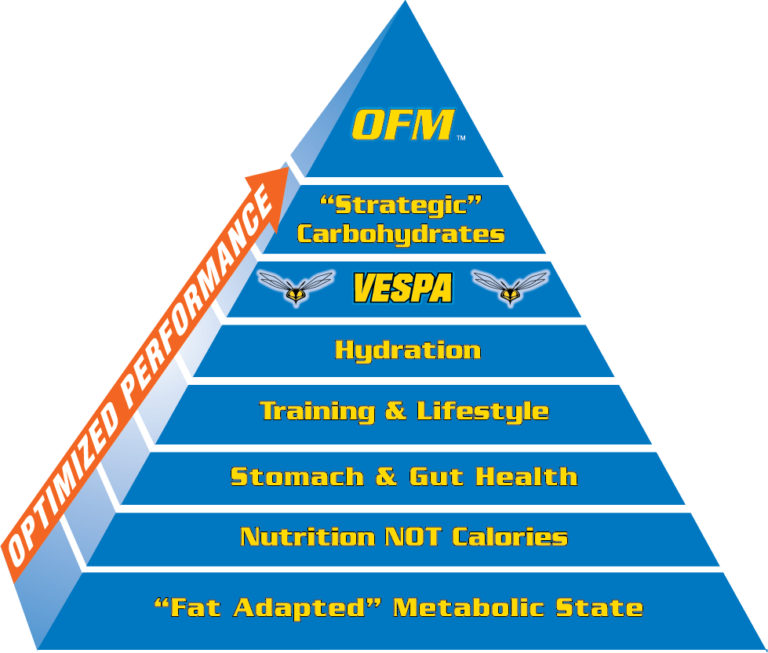
Optimized Fat Metabolism (OFM) is a comprehensive and individualized system which periodizes nutrition and training while addressing nutritional gaps in the diet, the biome (Stomach & Gut Health), and metabolic challenges as a result of our modern lifestyle in conjunction with the demands of training and competition.
OFM guides you to build the internal machinery. VESPA jump starts it.
Experience: With over 25 years of competition based field development across a variety of sports; ultra-endurance, triathlon, team sports, individual and tactical athletes, OFM and VESPA have yielded winning results in competition and longevity in sport.
- OFM Program — Metabolically focused: Reset / Adapt / Integrate
- OFM Coaching & Consulting — Accelerate & Leverage your journey with our 1:1 or Group Coaching Programs or work with an Affiliate Coach (in development)
- AuVentures Wellness Platform — In development
Fair questions, straight answers.
Won't I lose top-end speed without carbs?
My coach's plan says 90g of carbs per hour.
That plan is built for a gut that has to supply nearly all the fuel. When fat covers a bigger share of the demand, the same pace needs far less exogenous sugar — and the gut stops being the limiter.
Does this work for a marathon as well as a hundred-miler?
Do I have to go low-carb to use this?
How fast will I notice something?
Is VESPA a stimulant?
Stop training your gut to survive more sugar. Train your metabolism to need less of it.
Run the back half on the fuel you already carry — fewer gels, a stomach that stays online, and legs that still answer on the last climb.